

SMT Conveyor
What Is SMT Conveyor
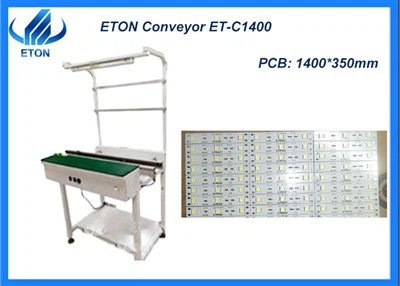
An SMT Conveyor, or Surface Mount Technology Conveyor, is a type of conveyor system used in electronics manufacturing to transport printed circuit boards (PCBs) between different stages of the assembly process. SMT Conveyors are designed to handle delicate PCBs with components already placed on them without causing damage. These conveyors can be configured with adjustable speed settings, width adjustments, and various types of guiding mechanisms to ensure smooth and efficient movement of PCBs through the assembly line. SMT Conveyors play a critical role in automating the production process and optimizing the workflow in electronics manufacturing facilities.
Advantages of SMT Conveyor
Cost-effectiveness
SMT conveyor are a cost-effective solution for moving materials, as they require relatively simple equipment and minimal maintenance.
Speed and efficiency
SMT conveyor belts can move materials quickly and efficiently over long distances, reducing the need for manual labor and increasing productivity.
Safety
SMT conveyorbelts are designed with safety features such as guards and emergency stop buttons, reducing the risk of accidents in the workplace.
Versatility
SMT conveyor can be customized to handle a wide range of materials and products, making them suitable for use in a variety of industries and applications.
Continuous operation
SMT conveyor belts can operate continuously, reducing downtime and maximizing the flow of materials.
Automation
SMT conveyor can be automated, reducing the need for manual labor and improving consistency and accuracy in material handling processes.
Space utilization
SMT conveyor belts can be designed to optimize the use of space in a facility, reducing the need for additional storage or handling equipment.


Why Choose Us
Sales Market
We have a large market share in the USA, Korea, India, Germany, and Turkey, as well as in more than 20 other countries. Our local engineers in India (Delhi, Mumbai, and Daman), Turkey, Egypt, and elsewhere provide great convenience.
Technology Patent
We focus on professional and efficient technology development and innovation. We hold 9 invention patents, 112 practical patents, and 12 software copyrights. Additionally, ETON has invented the fastest automatic pick-and-place machine, capable of a speed of 250,000 CPH.
Our Certificates
We have several important certificates, including the CE certificate, the CCC certificate, and the SIRA certificate. Each of these certificates demonstrates our commitment to quality and safety.
Our Services
ETON offers comprehensive services: pre-sale, on-sale, after-sale, and technical support. Our professional service team has rich experience to ensure we address our customers’ questions. We always strive to provide the best support to you!
Types of SMT Conveyor



PCB belt conveyor
A belt conveyor is a popular choice for transferring components within an assembly line. The system consists of one or more rotating belts driven by motors that move parts from one station to the next. Advantages include accuracy, reliability, cost-effectiveness, flexibility and adaptability for use with multiple types of production machines.
Inspection PCB conveyor
Inspection conveyors are equipped with features like lighting, magnification, and inspection stations to allow operators to examine PCBs closely during the assembly process. These conveyors are essential for quality control.
Slat chain conveyors
Slat chain conveyors use interlocking slats to transport PCBs or components. They are ideal for applications where stability and precision are crucial, such as when dealing with delicate or oddly-shaped PCBs.
Link conveyors
Link conveyors consist of interlocking links that provide a stable and reliable platform for PCB transport. They are used in environments where precision and synchronization are critical.
Buffer conveyors
Buffer conveyors are used to temporarily store PCBs between different assembly stages. This prevents production bottlenecks and allows for smoother operations.
Turn conveyors
Turn conveyors are used to change the direction of PCB flow, allowing for smooth transitions between different assembly stations.
Application of SMT Conveyor
Manufacturing and assembly lines
They facilitate the smooth movement of components and finished products within production facilities, enhancing efficiency and reducing manual handling.
Agriculture and farming
SMT conveyor are employed in agricultural settings for tasks such as loading/unloading of crops, sorting, and packaging.
Warehousing and distribution centers
They play a pivotal role in the logistics industry for sorting, packing, unloading, and unloading, and transporting goods within warehouses and distribution centers.
Airports and baggage handling
SMT conveyor are instrumental in swiftly moving luggage and cargo between terminals, ensuring timely departures and arrivals.
Food processing and packaging
They are used for conveying ingredients, processing various food products, and packaging operations in the food industry.
Retail and e-commerce
SMT conveyor are employed in retail settings for tasks like moving goods to and from storage areas and facilitating order fulfillment.
Components of SMT Conveyor
The belt is the main component you can see when looking at a conveyor belt system. The primary function of the belt is to transport the products or materials from one place to another. The belt itself can be made of various different materials depending on the situation. This includes nylon, polyester, rubber, stainless steel, and thermoplastics.
The main role of the belt support is to ensure the belt itself does not sag or become misaligned. This ensures the conveyor belt is maintained over time. Heavier loads can also be transported with ease without damaging the belt in the long run.
The pulley plays a crucial role in the movement of the conveyor belt. Drive pulleys are connected to the motor, which transmits motion to the conveyor belt. This causes the belt to move allowing for the transport of materials. This means the direction of the conveyor system can also be controlled. Idler or redirect pulleys guide the belt in whichever direction you prefer.
The drive unit is comprised of an electric motor, gearbox, and other drive components. Connected to the pulley, the drive unit powers the movement of the conveyor belt. This enables products and materials to be transported.
Roller conveyor systems have a slightly different composition. Instead of a belt, a set of rollers are used to transport products. These rollers are cylindrical tubes or wheels placed parallel to each other along the length of a conveyor.
Transporting PCBs to pick and place machines
The first step in any SMT line is picking and mounting electronic components onto PCBs. During this process, conveyors transport the bare PCBs to pick and place machines as swiftly as possible. The machines scan the PCBs for electronic components, read their position on the PCB, and mount them on the surface of the PCB. Without conveyors, the process would be slow, manual, and prone to errors. The conveyors help move the PCBs quickly, accurately, and consistently across the pick and place machines.
Transporting PCBs to soldering machines
Once the PCBs have electronic components mounted on their surface, they need to be heated to ensure proper attachment and ensure that they are firmly in place and will not come off during use. Soldering machines heat up the PCBs, melting the solder to form an electrical connection between the components and the board. As the PCBs are being heated, conveyors move them steadily from one machine to another, ensuring that they are heated uniformly.
Transporting PCBs to inspection
Before the PCBs reach the final stages of production, they need to be inspected thoroughly to ensure that there are no defects or problems. The conveyors transport the PCBs to inspection machines where they are scrutinized for any errors, such as misplaced components, bad electronic connections, or solder bridges. Conveyors ensure that PCBs move rapidly and consistently through inspection machines, minimizing the time spent on inspection and quickly getting defective boards off the production line.
Transporting PCBs to testing
After inspection, the PCBs must undergo rigorous testing to ensure that they are fully functional and meet the required standards. Conveyors play a vital role in taking PCBs through different testing stations, where they undergo thorough checks to ensure they are working correctly. Through the use of conveyors, testing machines are better utilized, and they ensure that every board is effectively tested in a vastly shortened time frame.
Transporting PCBs to packaging
The final stage of SMT is packaging, where PCBs are packed to your specific requirements. Conveyors help to transport PCBs quickly and seamlessly to the packaging station where they will be packaged in the fastest and accurate manner possible to reduce lead times and improve delivery to the end customer.
How to Maintain SMT Conveyor
Develop a maintenance plan
Developing a maintenance plan is the first step to ensure that the conveyor system is properly maintained. The plan should specify the frequency of inspections and maintenance and the tasks that need to be performed. Depending on the workload of the smt conveyor, maintenance frequency may be daily, weekly, or monthly.
Regular cleaning
The conveyor belt should be kept clean to prevent material buildup and reduce friction, which can damage the conveyor belt and cause increased wear. Regular cleaning should include removing debris, dust, and dirt from the conveyor belt, rollers, and other components. We recommend air/wipe cleaning when contaminants are dry on the conveyor belt. In sanitary environments, full washdown and sanitation guidelines are recommended.
Belt inspection
Tension-free belts make smooth operation of dynamic smt conveyors very simple and require little maintenance. The conveyor belt should be inspected regularly to detect any problems. Look for signs of wear, damage, belt elongation, and misalignment. Resolve any problems immediately to prevent further damage.
Inspection of smt conveyor components
Smt conveyor components should be inspected regularly to detect wear and damage. This includes belts, rollers, bearings, motors, gearboxes, and other components. Any damaged components should be replaced promptly to prevent further damage to the system.
Proper loading
Properly loading the conveyor system will help reduce tension on the conveyor belt. Make sure the load is evenly distributed across the width of the conveyor belt and avoid overloading the conveyor belt.
Electrical connections
Electrical connections should be checked regularly to ensure they are tight. Loose connections can cause arcing, which can damage the electrical components of the conveyor system.
SMT Conveyor Manufacturing Process Details
Material preparation and review
The SMC and PCB are prepared and checked for any defects. Pcbs usually have flat, tin-lead, silver or gold plated copper pads without holes, called pads.
Stencil preparation
The stencil is used to provide a fixed position for solder paste printing and is made according to the designed position of the pads on the pcb.
Solder paste printing
Solder paste is usually a mixture of flux and tin, which is used to connect the smc and the pads on the pcb. It is applied to the pcb with a stencil and is scraped with a scraper at an angle ranging from 45°-60°.
SMT placement
The printed pcb then enters the placement machine, which is transported by a conveyor belt and the electronic components are placed on it.
Reflow soldering
After the circuit board is coated with smc, it needs to be placed in the reflow soldering of the soldering oven. The preheating zone is the first zone in the oven where the temperature of the circuit board and all components rises. In this section, the temperature rises at a rate of 1.0°c-2.0°c per second until it reaches 140°c-160°c. The board will remain in this zone for 60 to 90 seconds at 140°c to 160°c. The board next enters the reflow zone where the temperature rises at 1.0°c-2.0°c per second to a high of 210°c-230°c, melting the tin in the solder paste and attaching the component leads to the pcb pads. The surface tension of the molten solder helps to hold the components in place. The section is designed to ensure that the solder does not freeze when it leaves the heating zone, thus preventing connection defects.
Cleaning and inspection
After soldering, the board is cleaned and inspected for defects. Defects are reworked or repaired, and the items are then stored. Magnifiers, aoi (automated optical inspection), flying probe testers, and x-ray machines are all common SMT tools.

Factors to Consider When Choosing an SMT Conveyor Belt
Dimensions
There’s a lot that goes into selecting an appropriate SMT conveyor belt for your system, but some of the most important considerations are the length and width of the belt. Taking care of the accurate dimensions for your belt is imperative to the best belt selection. The process of gathering dimensions enables your belting representative to rule out some belt constructions.
Decline or incline requirements
You need to consider the movement of the SMT conveyor when you choose the best for your applications. If the belt moves in an upward or downward direction, there might be a chance that the product sitting on it would slip or shift. To avoid this, the belt should have a stopper that will keep your product in place.
Environmental conditions
Environmental conditions must be considered before you purchase a belt. It is important to understand the type of environment in which your SMT conveyor will be placed. Some belts made of certain materials may not be able to withstand extreme hot or cold temperatures. Also, the material transported is important. For instance, if oil cans are transported, and by any chance, the oil spills onto the container, it may hamper the working.
Product specifications
Listing the type of products being conveyed on the SMT conveyor belt is a critical step in selecting the best belting option for your application. Significant details include the weight, size, and type of the products being conveyed.
Weight
The weight of the product is one of the important considerations while selecting an appropriate belt because heavy materials can bend or wrap the belt. To keep the system running properly you will need to determine the weight of your product.
Size
The size of the product should be the next consideration when you purchase a belt. Your product should fit comfortably on the belt surface. If not, it can get entangled in the conveying machine.
Type
The type of SMT conveyor belt you choose should be as per the product you need to transport. For example, if you are planning to transport metal products then you need something that withstands with sharp edges and filings.
How the SMT Conveyor Works
Motor and power source
The SMT conveyor system is typically powered by an electric motor connected to a power source. The motor provides the necessary rotational power to drive the SMT conveyor belt.
Belt structure
The SMT conveyor belt is made up of a continuous loop of material, such as rubber or fabric-reinforced with steel cords. It is supported by a series of rollers or pulleys, which help maintain the belt's alignment and facilitate its movement.
Loading point
Objects or materials to be transported are placed onto the SMT conveyor belt at the loading point. This can be done manually or through an automated process, depending on the application.
Belt movement
When the motor is activated, it drives the rollers or pulleys, causing the SMT conveyor belt to move. The belt moves in a continuous loop, with the top surface carrying the objects or materials along the desired path.
Carrying objects
As the belt moves, the objects on the SMT conveyor belt are carried forward. The design of the SMT conveyor belt may include features such as cleats, ridges, or side walls to prevent items from sliding or falling off the belt during transportation.
Unloading point
The SMT conveyor belt continues to move until it reaches the unloading point. At this point, the objects or materials are unloaded from the SMT conveyor belt, either manually or through an automated process, depending on the specific setup.
Return loop
After the objects are unloaded, the empty SMT conveyor belt typically forms a return loop to prepare for the next cycle. In some systems, the belt may pass through additional rollers or pulleys to maintain tension and support its return journey.
What Are the Trends and Development Directions of SMT Conveyor in the Market
Smart SMT conveyor systems
One of the most significant advancements in SMT conveyor belt technology is the integration of smart systems. Intelligent SMT conveyor belts are equipped with sensors, cameras, and other IoT (Internet of Things) devices, allowing them to gather real-time data on product movement, speed, and condition. This data is then analyzed using advanced algorithms to optimize the overall production process. Smart SMT conveyor systems enable predictive maintenance, reducing downtime and increasing the lifespan of the equipment.
Industry 4.0 integration
As industries embrace the fourth industrial revolution, SMT conveyor belt selection guides are evolving into integral components of supply chain 4.0. These smart SMT conveyor systems can be seamlessly integrated into larger networks, enabling communication between different manufacturing elements.
Lightweight and high-strength materials
Recent advancements in materials science have led to the development of lightweight yet high-strength materials for SMT conveyor belts. Carbon fiber, aramid fibers, and other composite materials are replacing traditional materials like rubber and steel, resulting in SMT conveyor belt selection guides that are not only stronger but also more energy-efficient. These lightweight materials contribute to reduced energy consumption, making SMT conveyor systems more environmentally friendly.
Energy-efficient designs
The push for sustainability in manufacturing has driven the development of energy-efficient SMT conveyor belt designs. Variable frequency drives (VFDs), regenerative braking systems, and advanced motor technologies are being integrated to optimize power consumption.
Improved safety features
Safety is a paramount concern in industrial settings, and SMT conveyor belt technology has not been left behind in this aspect. Advanced safety features, such as emergency stop systems, anti-jamming mechanisms, and smart sensors, are now standard in modern SMT conveyor designs. These features enhance worker safety and prevent accidents, reinforcing the role of SMT conveyor belts as reliable and secure components in industrial environments.
Shenzhen ETON Automation Equipment Co.,Ltd. is a leading manufacturing and process solution provider focusing on R&D, production, sales, and service of SMT high-speed pick and place machines and SMT peripheral automation equipment. ETON has SMT high-speed pick and places machine division, precision solder paste stencil printer division, high-speed precision dispensing equipment division, and SMT peripheral automation equipment, division. ETON obtains a number of intellectual property technologies, including 9 invention patents, 112 practical patents, 12 software copyrights..


Our Certificate
CE certificate,CCC ce rtificate,SIRA certificate


Video
FAQ
We're well-known as one of the leading smt conveyor manufacturers and suppliers in China. If you're going to buy high quality smt conveyor with competitive price, welcome to get quotation from our factory.
Automatic SMT Bare Board Loader, Single rail SMT Conveyor Electronic Products, Nozzle Cleaning Machine