

How does the heating rate affect the soldering quality in an Smt Reflow Oven?
In the world of Surface Mount Technology (SMT), the reflow oven is a critical piece of equipment. It plays a pivotal role in soldering electronic components onto printed circuit boards (PCBs). One of the key factors that significantly influences the soldering quality in an SMT reflow oven is the heating rate. As a trusted SMT reflow oven supplier, I've witnessed firsthand how the heating rate can make or break the soldering process. In this blog, I'll delve into the relationship between the heating rate and soldering quality, and how you can optimize this parameter for the best results.
Understanding the Basics of SMT Reflow Soldering
Before we dive into the heating rate, let's briefly review the SMT reflow soldering process. It involves four main stages: pre - heating, soaking, reflow, and cooling. During pre - heating, the temperature of the PCB and components gradually rises to remove moisture and activate the flux. The soaking stage stabilizes the temperature across the board and further activates the flux. In the reflow stage, the solder paste melts, creating electrical and mechanical connections between the components and the PCB. Finally, the cooling stage solidifies the solder joints.
Impact of Heating Rate on Solder Joint Formation
Pre - heating Stage
The heating rate in the pre - heating stage is crucial. A too - slow heating rate can lead to insufficient flux activation. Flux is essential as it removes oxides from the metal surfaces and prevents re - oxidation during the soldering process. If the flux is not properly activated, it may leave residues on the PCB, which can cause electrical shorts or poor solder joint reliability over time.
On the other hand, a too - fast heating rate in the pre - heating stage can cause thermal shock to the components. Components such as ceramic capacitors and integrated circuits are sensitive to rapid temperature changes. Thermal shock can lead to cracking in the components, which will ultimately result in a non - functional PCB.
Soaking Stage
During the soaking stage, a moderate and stable heating rate is required. This stage allows for uniform temperature distribution across the PCB. If the heating rate is inconsistent, some areas of the board may not reach the optimal temperature for flux activation and solder melting. For example, components in the center of the board may heat up more slowly than those at the edges. An improper heating rate can lead to uneven solder joint formation, with some joints being under - soldered while others are over - soldered.
Reflow Stage
The heating rate in the reflow stage directly affects the quality of the solder joints. A slow heating rate may result in incomplete melting of the solder paste. This can lead to cold solder joints, which are characterized by a dull appearance and poor electrical conductivity. Cold solder joints are prone to failure under mechanical stress or temperature cycling.
Conversely, a very fast heating rate in the reflow stage can cause the solder to splash or ball up. This is because the rapid temperature increase can cause the flux to vaporize too quickly, creating bubbles in the molten solder. These bubbles can disrupt the flow of the solder, resulting in irregular and unreliable solder joints.
Factors Affecting the Heating Rate
Oven Design
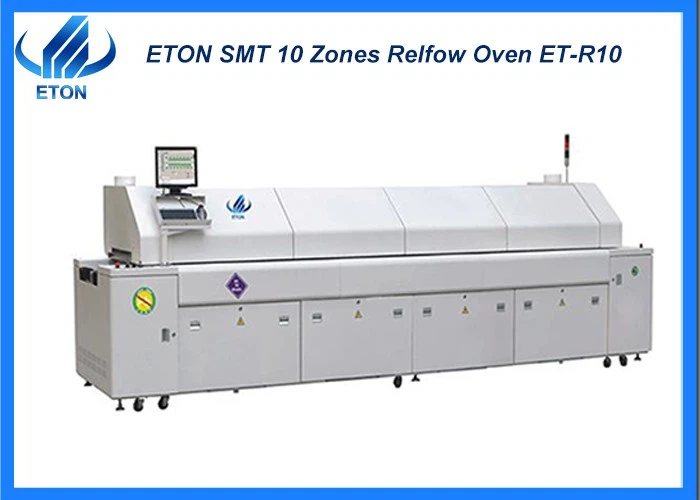
The design of the SMT reflow oven has a significant impact on the heating rate. For example, the number of heating zones in the oven affects how precisely the temperature can be controlled. Our 90KW Power 10 Zones SMT Reflow Oven Machine has multiple zones, which allows for more accurate control of the heating rate in each stage of the soldering process. The width of the conveyor belt also matters. A wider belt may require a higher heating power to achieve the same heating rate as a narrower belt. Our 450mm Mesh Belt Reflow Oven Machine is designed to provide efficient heating for a variety of PCB sizes.
Airflow
The airflow inside the reflow oven is another important factor. Proper airflow ensures uniform heat transfer to the PCB and components. Inadequate airflow can result in hot and cold spots, which can cause uneven heating rates across the board. Our Reflow Oven Soldering Machine 8 Zones is equipped with advanced airflow systems to ensure consistent heating throughout the soldering process.
PCB and Component Characteristics
The size, shape, and material of the PCB and components also influence the heating rate. Larger PCBs or components with high thermal mass require a slower heating rate to ensure uniform heating. For example, a thick - copper PCB may heat up more slowly than a standard FR - 4 PCB. Components with complex geometries may also have different heating requirements.
Optimizing the Heating Rate for Quality Soldering
Temperature Profiling
Temperature profiling is a crucial step in optimizing the heating rate. This involves using a thermal profiler to measure the temperature of the PCB at different points during the soldering process. By analyzing the temperature profile, you can adjust the heating rate in each zone of the oven to achieve the desired soldering results.
Process Monitoring
Continuous process monitoring is essential to ensure that the heating rate remains consistent. Our reflow ovens are equipped with advanced sensors and control systems that allow for real - time monitoring of the temperature and heating rate. Any deviations from the set parameters can be detected and corrected immediately.
Staff Training
Proper staff training is also important. Operators should be well - trained in understanding the relationship between the heating rate and soldering quality. They should know how to adjust the oven settings based on the characteristics of the PCB and components being soldered.
Conclusion
The heating rate is a critical factor that affects the soldering quality in an SMT reflow oven. By understanding how the heating rate impacts each stage of the soldering process and taking into account the various factors that influence it, you can optimize the soldering process for high - quality results. As a leading SMT reflow oven supplier, we are committed to providing you with the best equipment and technical support to help you achieve excellent soldering quality.
If you're interested in learning more about our SMT reflow ovens or need assistance in optimizing your soldering process, we encourage you to contact us for a detailed discussion. Our team of experts is ready to help you find the right solutions for your specific needs.
References
- "Surface Mount Technology: Principles and Practice" by J. R. Humpston and D. M. Jacobson
- "Soldering in Electronics" by E. J. Vianco and J. H. Lau